 Mike Lee
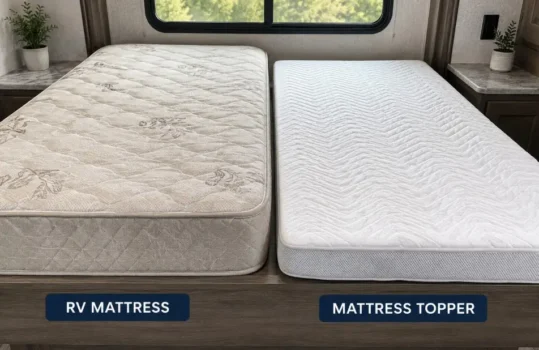
Here’s the short answer. If the bed in your camper is just too hard or too thin, a good topper will fix it for a lot less money. If the bed sags, has lumps or is the wrong size, replace the whole thing.
That’s the whole choice in one sentence. The rest of this guide helps you figure out which one you need, what size to get, and how to avoid paying too much.
The bed in a camper has a way of sneaking up on you. You sleep great at home. Then you spend two nights on the road and wake up sore. The good news is that fixing it is easier than you think. There are no wrong questions here.
Why camper beds are their own headache
You’d think a queen is a queen. It isn’t.
Campers use their own sizes. A “Short Queen” is about 60 inches wide and 75 inches long. A regular home queen is 80 inches long. So a normal sheet set and a normal bed won’t fit right. There’s also the RV King, the Three-Quarter and the bunk size for kids.
Some beds even have a cut corner. That notch clears a wheel well or a slide-out. If your bed has one, a plain rectangle won’t fit.
So step one isn’t shopping. It’s measuring.
Measure before you buy anything
Grab a tape measure. Write down three numbers:
- Length (top to bottom)
- Width (side to side)
- Depth (how thick the bed is)
Then check the corners. Are they square, rounded or cut at an angle? If a corner is cut, measure how deep the notch goes and which corner it’s on. Snap a photo with your phone too.
Here’s why this matters. A “Short Queen” from one brand isn’t always the same as another brand. The label lies sometimes. Your tape measure doesn’t.
To put it in real numbers: if you guess and you’re off by two inches, you could be paying to ship a heavy bed back. That’s a $50 to $100 mistake. Measuring takes five minutes.
Topper or new bed! Make the call
This is the big question, so let’s make it simple.
Get a topper if the bed underneath is still solid but just uncomfortable. Maybe it’s too firm. Maybe it’s a little thin. A topper sits on top and adds cushion. It costs way less.
Get a new bed if the bed sags in the middle, has broken springs, smells musty or is the wrong size. A topper can’t fix a broken bed. It just hides the problem for a few weeks.
Quick test. Press your hand into the middle of the bed. Does it spring back, or does it stay sunk in? If it stays sunk, you need a new one. If it bounces back but feels like a board, a topper will do.
Picking a new bed
Say you need a full replacement. You’ve got three main types.
Foam. This is the pick for most people. Foam is light, which matters a lot in a camper because every pound counts. It also bends, so it can fit tight spaces and cut corners. And it’s usually the best price.
Hybrid. This is foam on top of springs. You get more support and better airflow, so it sleeps cooler. But it costs more and weighs more.
Innerspring. This is the old-school bouncy bed. It feels familiar. But it’s heavy, and you can’t cut it to a custom shape. For a camper, it’s usually the weakest choice.
Two more things to check. First, firmness. Side sleepers usually want softer. Back and stomach sleepers usually want firmer. Second, depth. If your new bed is much taller than the old one, your fitted sheets might pop off in the night.
Picking a topper
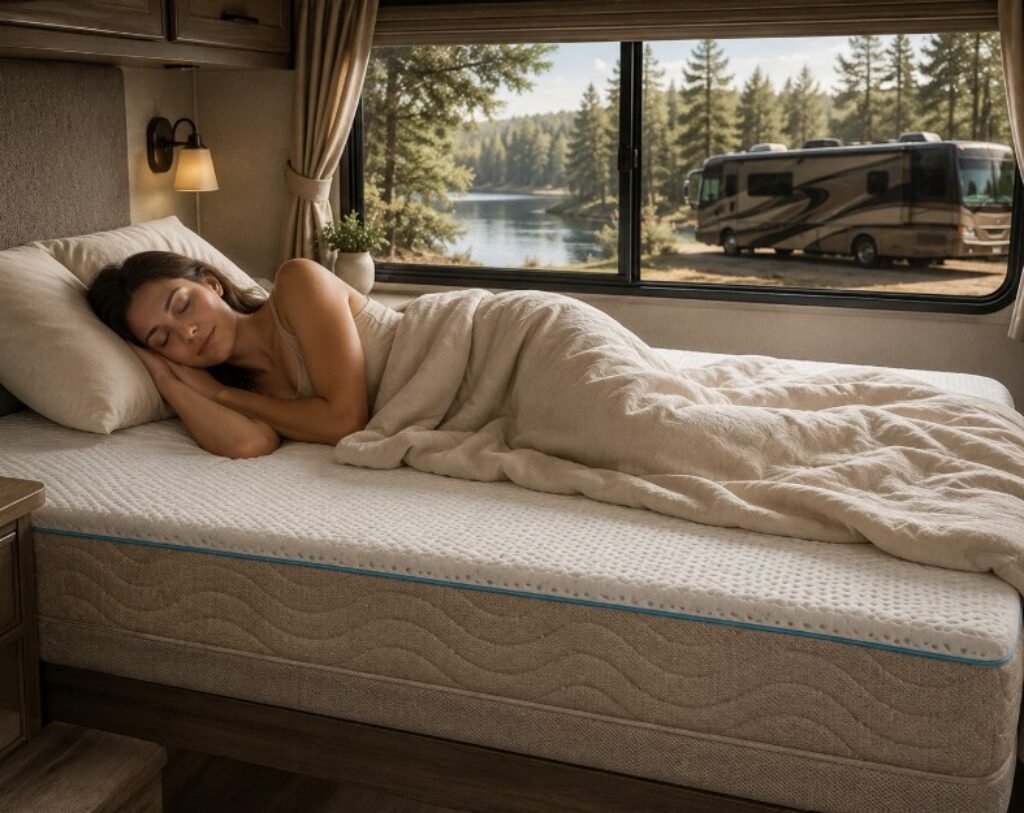
Going the topper route? Here are your options in plain words.
Memory foam. It hugs your body and helps with a bad back or sore hips. The downside is it can sleep warm.
Gel foam. This is memory foam with a cooling layer mixed in. A good pick if you sleep hot.
Latex. Bouncier and cooler than memory foam, and it lasts a long time. But it’s the priciest and the heaviest.
Thickness usually runs 2 to 4 inches. A 2-inch topper adds a little softness. A 3 or 4-inch topper makes a bigger change. Thicker isn’t always better, though. Too thick and you’ll feel like you’re rolling off the bed.
What it all costs
Let’s talk about real money so you know what’s fair.
A topper usually runs $80 to $250, depending on the type and size. Memory foam sits on the cheaper end. Latex sits on the higher end.
A full replacement bed usually runs $300 to $900. Foam beds are at the low end. Hybrids climb higher. A custom size or a cut corner can add $50 to $150 on top.
See the gap? That’s why a topper is the smart fix when the base bed is still good. You’re spending $150 instead of $600 to solve the same sore back.
Where to buy
You’ve got three main places, and each has a trade-off.
Online specialty shops are the sweet spot for most folks. They make custom sizes, they ship to your door and the price is usually fair. This is where to start if you have an odd size or a cut corner.
Big online stores like Amazon work fine for standard sizes and toppers. Just double-check the size, because true camper sizes can be hard to find there.
The dealership is the easy button. They’re handy and they know the odd sizes. But you’ll pay the most. Use them when you want it handled fast and don’t mind the markup.
Questions to ask before you pay
Before you hand over your card, ask these:
- What’s the return policy on a custom size? (Custom orders are often final sale.)
- Is there a sleep trial, and how long?
- How firm is it, really?
- How thick is it, so my sheets still fit?
- How much does it weigh?
- How long until it ships?
Write the answers down. If a seller won’t answer, that’s your answer.
Your next step
Don’t overthink this. You’re close.
Go measure your bed today. All three numbers, plus the corners. Then do the hand-press test in the middle. That one test tells you if you’re in the topper camp or the new-bed camp.
Once you know, get one quote before you buy. Just one. Compare it to the price ranges above so you know you’re paying a fair number. Then make the call and get a better night’s rest.
You don’t need to be an expert to get this right. You just need a tape measure and five quiet minutes.