 Mike Lee
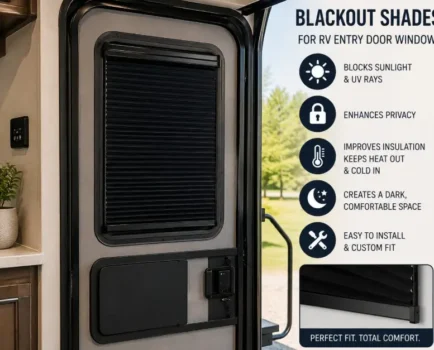
You climb into bed, pull the shade down over the door window, and expect the rig to go dark. But a thin line of light sneaks in around the edge, coming from a security light two sites over, and no amount of shifting your pillow makes it go away.
That’s the entry door window. It’s the hardest window in the whole rig to block, and most RVers don’t figure out why until they’ve already bought the wrong shade twice.
Why the door window is the hardest one to block
Most RV windows are simple rectangles. The door window usually isn’t. It’s smaller, it’s shaped oddly, and it sits close to whatever light source your campsite happens to have that night.
Three things work against you here:
- The shape. Door windows are rarely a clean rectangle. Some curve at the corners. Some taper toward the top.
- The location. Doors face walkways, parking pads, and campground light poles more often than bedroom windows do.
- The wear. You open and close that door a dozen times a night for the dog, the bathroom, a forgotten cooler. Whatever covers the window has to survive that.
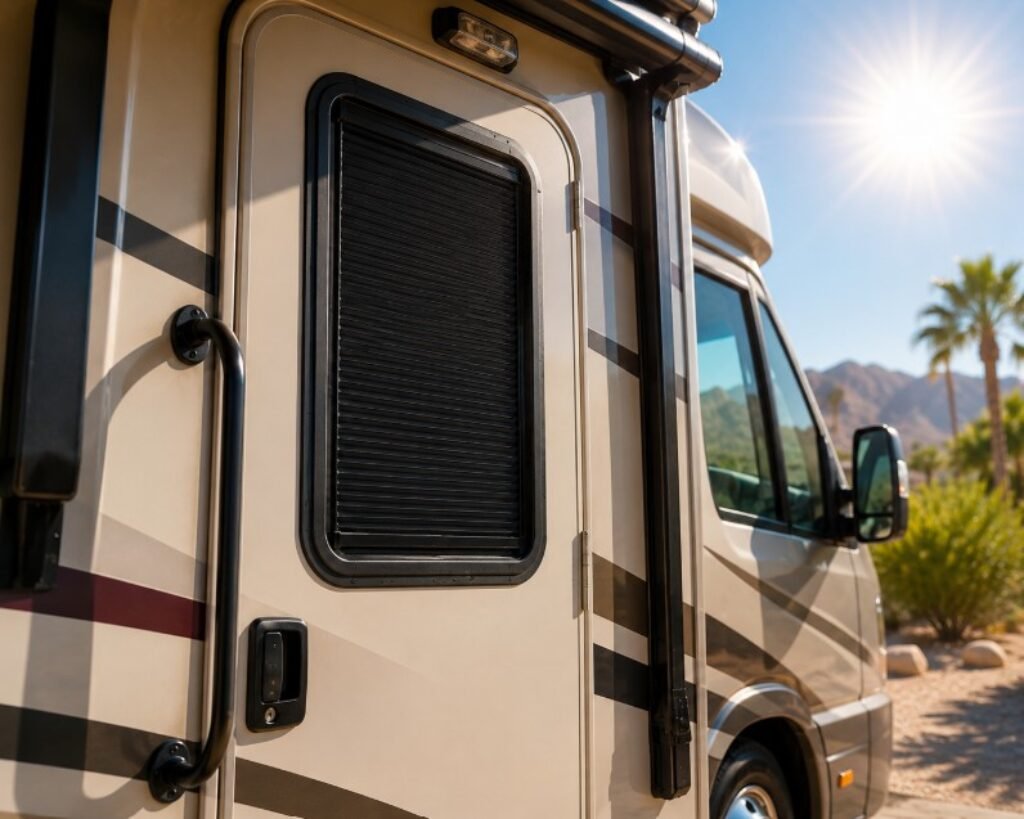
What actually blocks light on this window
You’ve got four real options. Each one trades convenience for durability in a different way.
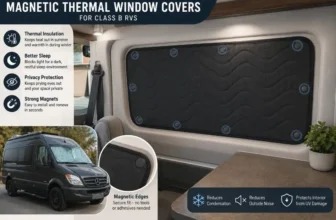
Magnetic blackout panels
These stick to the metal door frame. No adhesive, no drilling.
Renters and part-timers like these because nothing gets modified. The trade-off: weak magnets shift or rattle when the door slams, especially on a windy site. Look for panels rated for a snug, tight fit rather than the cheapest one on the shelf.
Suction cup shades
Cheapest option. Easy to find. Easy to test before you spend real money.
But suction cups fail in heat and cold. RV door windows take hours of direct sun in a lot of campsites, and that heat softens the suction over a single afternoon. Treat this as a short-trip fix, not a permanent one.
Custom-cut static cling film
You cut this to the exact shape of your window with scissors. No hardware at all.
It’s a great one-time install. But removing it mid-trip, then putting it back, gets old fast. It also doesn’t sit flat if your window has any curve or beveled edge.
Sewn curtain on a tension rod
This is the closest thing to a real blackout curtain. It works if there’s a few inches of flat frame around the glass to hang the rod on.
You have to measure this one for real, not by eye. RV door windows are almost never a standard rectangle, and a tension rod curtain that’s even a little off leaves gaps on both sides.
Picture your last few nights in the rig
Think about the porch light two sites over. The motion light that trips every time someone walks their dog past your rig. The glow leaking around the edge of a suction cup shade that’s already peeling loose at one corner.
None of that is random bad luck. It’s almost always a sizing problem, not a product problem. The wrong fix, even a good one, still leaves a gap.
Measure before you buy anything
Grab a tape measure before you open a single product page. Ask yourself:
How tall is the window, frame to frame? How wide? Is it a true rectangle, or does it taper near the top? Is there a flat frame around the glass, or does the window sit flush with the door?
A shade that’s a half inch short on any side leaves a light gap. And at night, your eyes find that gap first, every single time.
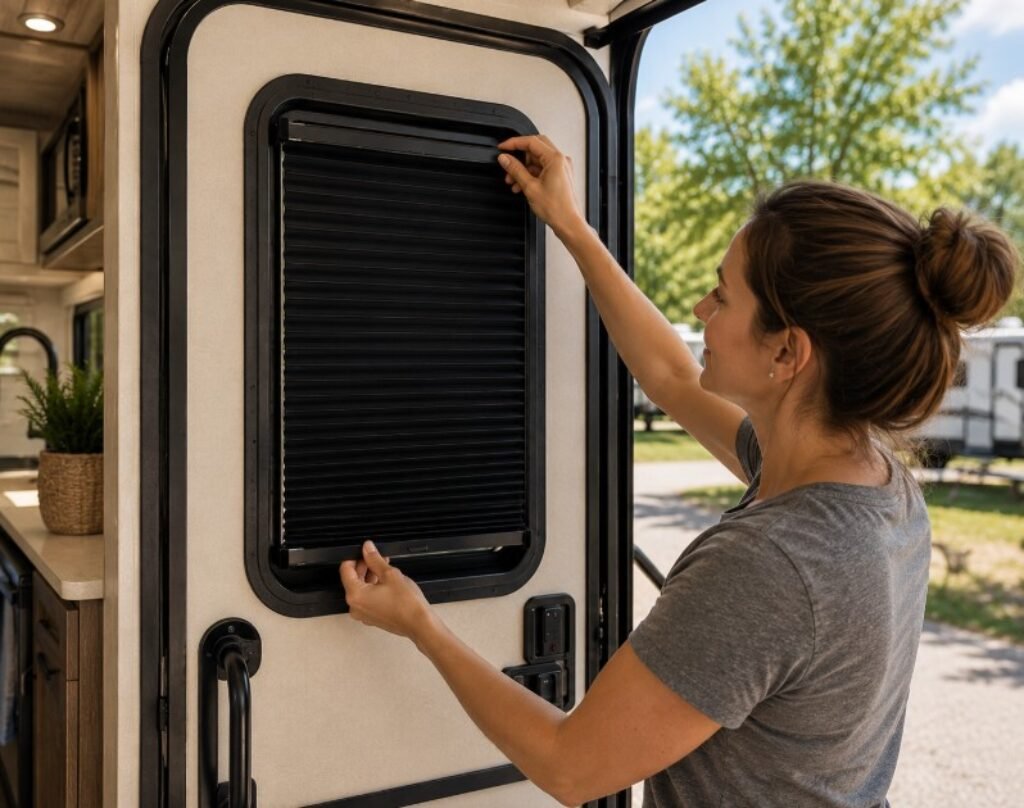
What to check before you buy
Once you know your measurements, run through this list before you commit to a product:
- Mount type: magnetic, adhesive, tension rod, or clip-on
- Whether it holds up to daily door use, not just a single test
- Whether it has to come down every time someone opens the door, or stays in place
- Whether it’s washable
The real trade-off comes down to this. Something removable works with the door and moves with your routine, but it takes light-blocking power to make it work that way. Something permanent blocks more light, but somebody has to take it down every time the dog needs a walk at 2 a.m.
When a blackout shade isn’t the right fix
A shade isn’t always the answer, and it’s worth saying so plainly.
If light is leaking in around the door frame itself, not through the window glass, a shade won’t fix that. That’s a weatherstripping problem, and no amount of fabric over the window solves a gap in the seal.
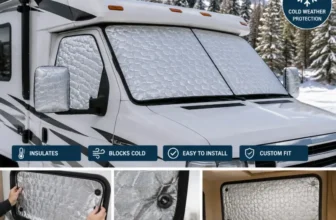
If your door takes full sun for hours before bedtime, a shade helps with the light you can see. It does much less for the heat coming through the glass. Pair it with reflective window film if heat is the bigger complaint in your rig.
And if your window is round, oval, or heavily beveled, a flat shade may leave permanent gaps no matter how carefully you measure. Some shapes just don’t take a flat cover well.
A simple setup that actually holds up
For the toughest doors, combine two layers. Use a magnetic panel for the nightly blackout, and back it up with static cling film along any edge where light still sneaks through.
Two layers cost more than one. But they solve the two different problems, shape and gap, that a single shade usually can’t handle alone.
Getting that door window dark isn’t about buying the priciest shade on the shelf. It’s about matching the mount to how you actually use the door, and closing every gap the light can find. Measure the window tonight, while you still remember to. Then pick the fix that fits both the shape of that glass and the way you live in your rig. Do that once, and the strip of light tracing your door at midnight stops being part of the routine.
Before you buy anything
You don’t need the fanciest shade on the shelf. You need one that fits the shape of your door window and matches how you actually use that door every night.
Measure the window tonight, while you’re thinking about it. Then pick the mount that fits both your window and your routine, magnetic if you’re in and out often, sewn if you’ve settled into one rig for good.
Get that part right, and the strip of light that used to find you at midnight stops showing up at all.
Frequently asked questions
Do RV entry door windows come in a standard size? No. Sizes vary by manufacturer and floorplan, so measure your own window instead of buying off a general size chart.
Will a magnetic shade fall off when I open the door? It can, if the magnets are weak or the panel is oversized. Look for a snug fit and strong-rated magnets instead of the cheapest option you find.
Can I use a regular window blackout curtain on my RV door? Usually not without cutting it down first. Residential curtains are made for bigger, evenly rectangular windows, and most door windows aren’t either.
What’s the cheapest way to block light on my RV door window tonight? A piece of cardboard or foam board, cut to size and wedged into the frame, works as a same-night fix while you shop for something more permanent.
Does a blackout shade help with heat too, or just light? It helps a little, but a shade isn’t built for heat the way reflective window film is. Pair the two if the heat is what’s really bothering you.