 Mike Lee
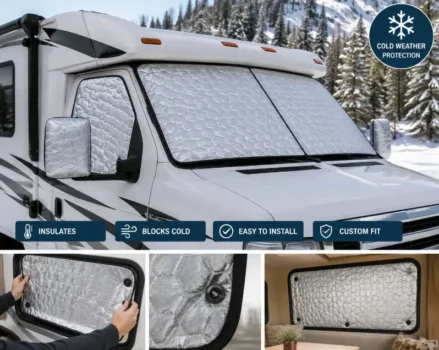
You wake up at 3 a.m. and the furnace kicks on again, third time since midnight. It’s 26 degrees outside. Under the blankets you’re fine, but the cheek facing the window feels like someone left a door cracked, and there’s a slow cold spill of air running down onto the mattress. By morning the sill has a puddle on it and you’re wiping glass with a hand towel before coffee.
But the furnace is doing its job. Most of the propane you’re burning is going straight out through 5 square feet of single pane glass 18 inches from your head, and a set of panels you can cut in one afternoon will keep that heat in the bed where you want it.
Why your windows leak more heat than the walls around them
Most RV windows are a single sheet of glass in an aluminum frame. Aluminum moves heat fast. The wall right next to that window is a sandwich of fiberglass, foam, and framing, and it holds heat far better.
The numbers get the point across. A typical RV sidewall lands somewhere around R-5 to R-7. Single pane glass sits close to R-1.
So a 30 by 24 inch bedroom window is about 5 square feet of surface that barely insulates at all, sitting 18 inches from your head.
Here’s what you’re actually feeling at 3 a.m. Warm air in the bedroom touches the cold glass, cools off, gets heavier, and slides down the window onto the bed. Then more warm air moves in to take its place and does the same thing. That loop runs all night long, whether the furnace is on or off.
Your furnace can’t win that fight. It can only keep feeding it.
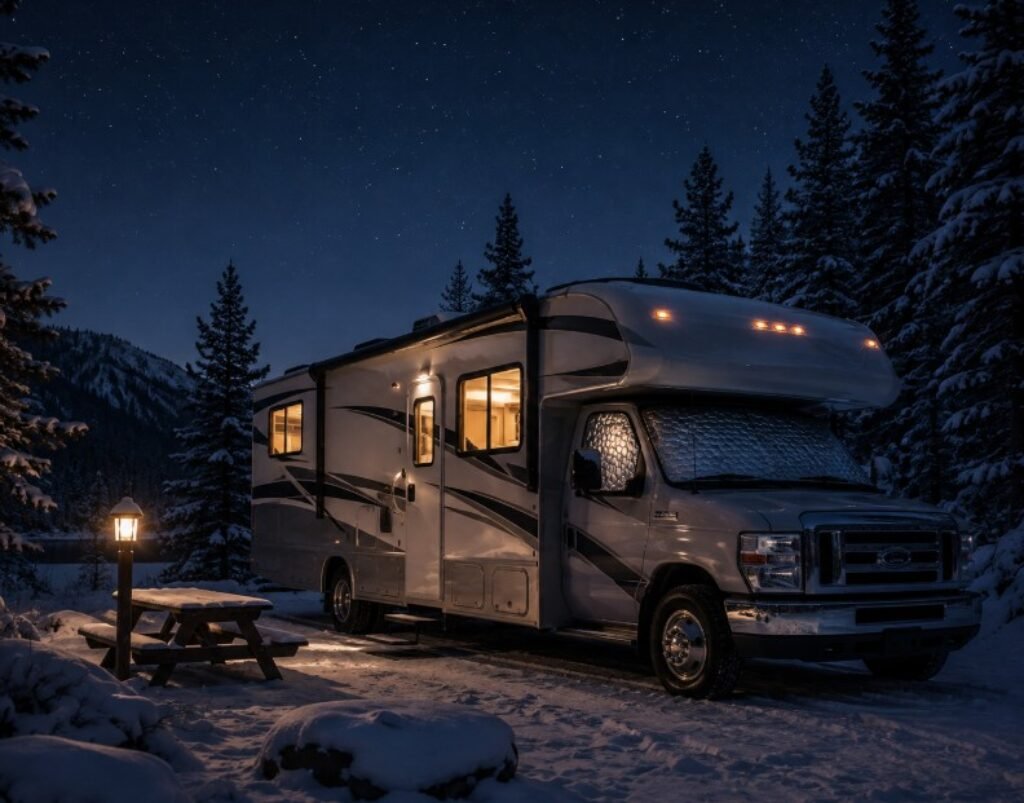
The four ways to cover an RV window in winter
Every option below does the same basic job. It puts a layer of something between your bedroom air and that cold glass. What changes is the cost, how long the install takes, and what you give up.
| Option | Material | Rough cost per window | Install time | Blocks daylight | Safe over an exit window |
| Reflective bubble panel | Foil-faced bubble wrap | Low | 2 minutes | Yes | Yes, if friction-fit only |
| Rigid foam board | XPS, EPS, or polyiso | Low to medium | 10 minutes | Yes | Yes, if friction-fit only |
| Quilted thermal cover | Fabric, batting, reflective layer | Highest | 10 seconds | Yes | Usually yes, check the mount |
| Shrink film or bubble wrap | Plastic film on the glass | Lowest | 15 minutes | No | No, it stays on the glass |
Reflective bubble panels
This is the silver foil bubble material sold in rolls. Reflectix is the name most people know. It runs about 5/16 inch thick and comes in 24 and 48 inch widths.
The R-value printed on the package assumes there’s an air gap next to it. Press it flat against bare glass and you lose a chunk of that. Leave a small gap and it performs the way it’s supposed to.
It cuts with a utility knife and a straightedge in under 2 minutes per window. That’s the whole appeal.
The tradeoff is what your rig looks like from the parking lot. Every covered window turns into a silver rectangle, and some campgrounds and HOA-run parks don’t love that look.
Rigid foam board cut to the glass
Foam board is the step up in real insulating power. XPS runs about R-5 per inch. Polyiso is closer to R-6. The white beadboard stuff, EPS, is around R-4.
A half inch board in a window well gives you a real gain and still bends just enough to snap into place.
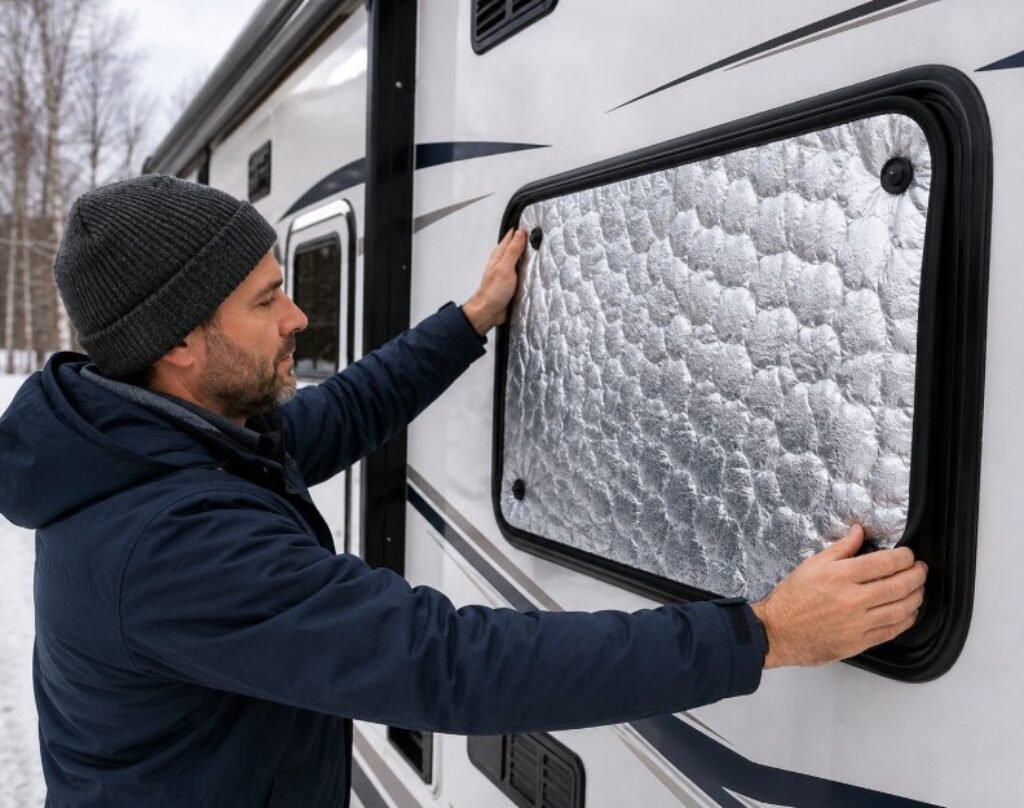
Cut it 1/4 inch bigger than the opening in both directions. It presses against the frame and stays put with no tape, no adhesive, no hardware. Same idea as a bathtub suction mat, where pressure does the holding.
The tradeoff is bulk. Four rigid panels take up real space in a rig that doesn’t have any to spare, and they don’t roll up.
Quilted thermal covers
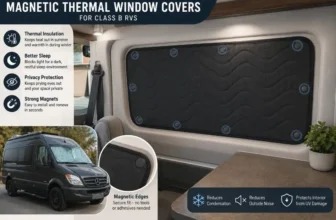
These are sewn covers with a reflective layer, batting inside, and magnets or snaps around the edge. You put them up at bedtime and pull them down in the morning in about 10 seconds.
They cost the most per window by a wide margin. What you buy is convenience, and if you’re parked somewhere with a nice view, you get your daylight back every morning without wrestling a foam panel out of a frame.
Shrink film and bubble wrap on the glass
Residential shrink film kits work on RV glass. You tape the film around the frame, run a hair dryer over it, and it pulls tight. That trapped pocket of still air is insulating.
Plain bubble wrap works too. Mist the glass with water, press the bubble side against it, and it sticks with no adhesive at all. It peels right off in spring.
Both of these let daylight through, which is the reason to pick them. Both stay on the glass for the season, so plan on them being semi-permanent.
How to cut a panel that actually stays put
Measure the glass opening first. Then measure the recessed lip of the frame. Those two numbers are almost never the same, and the second one is the one that matters for a friction fit.
Cut 1/4 inch oversize on both dimensions. The panel should need a little push to go in.
Label the back of every panel with the window it belongs to. Bedroom left. Dinette. Bath. In the dark, half asleep, that label saves you 5 minutes of guessing.
Before you start cutting, have these on hand:
- Tape measure
- Utility knife with a fresh blade
- Long straightedge or metal ruler
- Permanent marker
- Scrap cardboard to cut on
And here’s the part that catches people. A panel cut too small looks fine at bedtime and pops loose at 2 a.m. Ask anyone who’s had one land on the dog.
What to do about the water that shows up behind the panel
Covering the glass makes the glass colder. The moisture that used to fog up the window in plain sight now condenses behind the panel where you can’t see it.
Name it plainly. Trapped moisture sitting at the window frame is how you get black mold on the seals, and over a couple of seasons, a soft spot in the wall.
The path through it is simple and it takes 5 minutes a week.
- Crack a roof vent, even in cold weather
- Run a small fan to keep air moving in the bedroom
- Pull one panel every few days and dry the glass with a towel
- Watch the corners of the frame, since that’s where water sits longest
It also helps to know where the water is coming from. Two people breathing overnight puts a real amount of moisture into a small space. So does cooking, showering, and drying wet coats inside.
The biggest source is an unvented propane heater. Burning propane produces water as a byproduct, roughly a gallon of water for every gallon of propane. If you’re running a catalytic heater with no outside vent, window covers alone won’t fix your morning puddle.
When window covers are the wrong fix for your rig
Three situations where you should stop and rethink.
Your bedroom window is a marked emergency exit. That window has to open fast, one-handed, in the dark, by someone who’s scared. Nothing screwed in, nothing taped, nothing that takes two hands to remove. A friction-fit panel that falls out with a shove is fine. Anything more permanent is not.
You’re boondocking somewhere cold and sunny. The sun coming through your south-facing windows is free heat all day long, and it’s often the difference between running the furnace at 2 p.m. and not running it at all. Cover those at night and pull the panels at sunrise.
Your condensation is coming from an unvented heater or wet gear. Covers will move that water to a spot you can’t see. Fix the moisture source first, then insulate.
Questions to answer before you buy anything
Run through these and the right option usually picks itself.
Which 2 windows are closest to where your head goes? Do you want to take these down every morning, or leave them up until March? Does the window you’re about to cover open as an emergency exit? And where do 4 rigid panels live when they’re not in a window?
If you’re taking them down daily, pay for the fabric covers. If they’re staying up all season and storage is tight, foam board or bubble panels do the same job for a fraction of the money.
Common questions about cold weather RV window covers
Does Reflectix actually work on RV windows? It cuts the radiant heat loss and the draft you feel, and the real-world gain depends on leaving a small air gap between the foil and the glass.
Will covering my windows make condensation worse? It moves the condensation behind the panel where you can’t see it, so pair covers with a cracked roof vent and check the glass every few days.
Can I leave window insulation up all winter? You can on fixed windows, and you should keep any emergency exit window clear or covered with something you can knock out one-handed in the dark.
What’s cheaper, foam board or thermal covers? Foam board costs the least per window and thermal covers cost the most, and the fabric covers buy back daylight and 10-second removal.
Do I need to insulate every window or just the bedroom? Start with the 2 windows nearest the bed, since that’s where the draft costs you sleep, and add the rest if the rig still runs cold.
Go measure the two windows closest to your bed tonight. Write the numbers on your phone, glass opening first, then the frame lip, because those two rarely match. That’s the whole first step, and everything else here follows from those four numbers.
The next cold night, the furnace still cycles. But the air beside your head stays still, the sill stays dry, and 3 a.m. comes and goes without you.