 Mike Lee
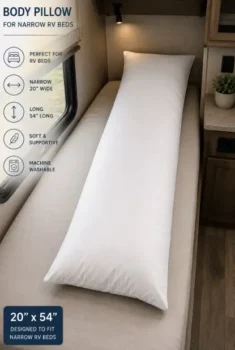
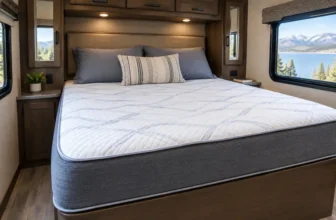
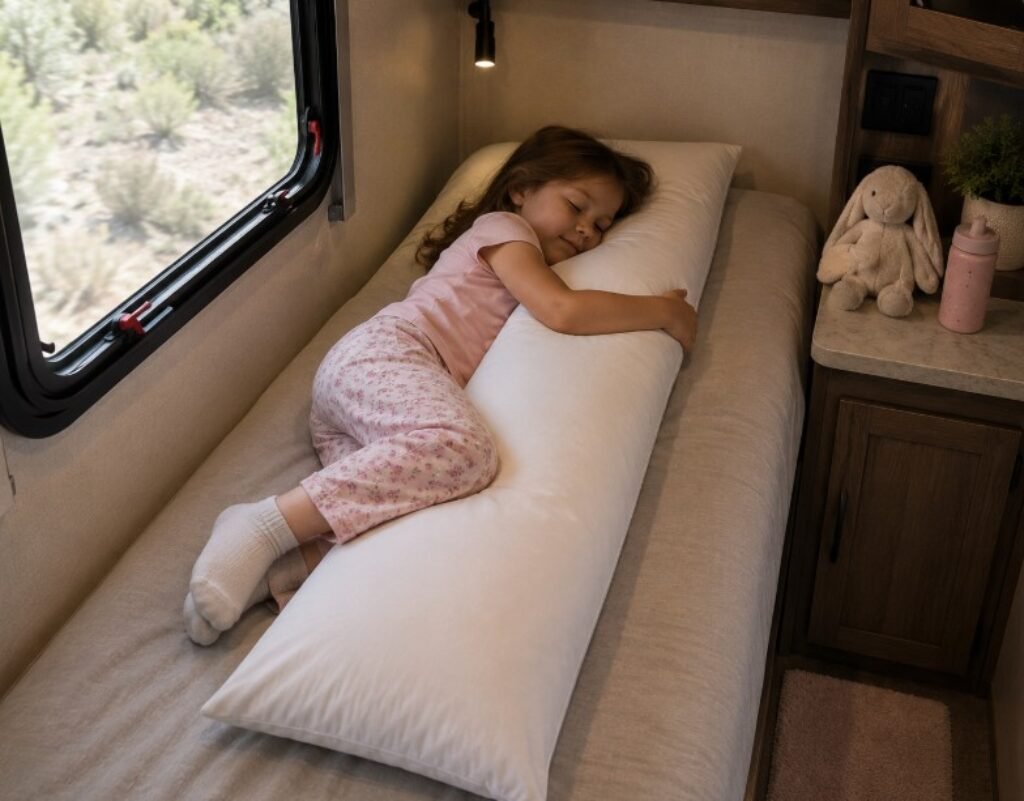
You climb into your camper bed, roll onto your side, and your elbow smacks the wall. Sound familiar? RV beds are tight. A regular body pillow either hangs off the edge or takes over the whole bed and shoves you toward the floor. But a body pillow is still one of the cheapest ways to sleep better in a camper. You just need the right size and the right shape for a small space.
Let’s walk through it together. There are no wrong questions here, and you don’t need to spend a lot to fix this.
Why a narrow bed changes everything
First, a quick reality check on size.
A standard RV “queen” is about 60 inches wide. But a lot of campers come with something smaller. You might have a “short queen” at 60 by 75 inches. You might have a bunk, a sofa bed, or a fold-down dinette that is even tighter. Some are only 48 to 54 inches across.
Now look at a normal body pillow. Most full-size ones are 20 by 54 inches. That is huge. Drop one of those onto a narrow bed and it eats up most of the space. You end up sleeping on the pillow instead of next to it.
So here is the trade-off, plain and simple. Too big, and the pillow pushes you off the edge. Too small, and it won’t hold up your knees and hips the way a good RV side sleeper pillow should. The goal is to find the sweet spot in the middle.
The short answer
For most narrow RV beds, skip the giant straight pillow. Go with a J-shape or a slim body pillow around 48 to 50 inches long.
Why? Because that size curves with your body instead of crowding you. It gives your head, your back, and your knees some support without grabbing the whole bed. For a lot of campers, that is the best body pillow for a short queen setup.
That’s the call. Now let me show you how I got there.
Body pillow shapes, explained in plain words
Body pillows come in a few basic shapes. The names sound fancy, but they are just letters that look like the pillow. Here is what each one does.
I-shape (straight): This is a long, simple tube. It’s the cheapest kind. You hug it in front or tuck it behind your back. Good for tight beds because it only takes up one strip of space.
J-shape: This one has a little hook at the top. The hook cradles your head while the long part runs down to your knees. You get head and body support without a huge footprint. This is my top pick for a narrow bed.
C-shape: This curves like the letter C. It wraps around your back and tucks under your head. Nice for back support, a little wider than a J.
U-shape: This hugs you on both sides at once, front and back. It feels amazing. But it is a space hog. On a narrow camper bed, a U-shape usually leaves no room for you. Save it for the bed at home.
If you only remember one thing, remember this. The simpler the shape, the easier it fits a small space.
How to size it right
Don’t guess. Measure.
Grab a tape measure and check how wide your sleeping space really is. Not the size on the brochure. The real space, wall to wall.
Then leave yourself room. Say your bed is 54 inches wide. A 54-inch pillow laid sideways would fill the whole thing. Instead, look at a pillow around 48 to 50 inches. That leaves a little breathing room so you are not wedged against the wall all night.
Here is a handy trick. Look for pillows with shredded foam or fluffy fill that you can squish and shape. These bend into tight spots and odd corners. A stiff, solid pillow won’t do that. It just sits there like a log.
Why the filling matters more than you’d think
The stuff inside the pillow changes how it feels and how long it lasts. Three kinds show up most often.
Memory foam: Holds its shape well and gives steady support. The downside? It traps heat. A camper warms up fast on a summer night, and foam can make you sweat. To put it in real numbers, a foam pillow can run you 40 to 70 dollars.
Shredded foam: This is foam chopped into little bits. It is the happy middle. You can fluff it, squish it, and shape it to fit a narrow bed. It breathes better than solid foam too.
Polyester (poly-fill): The cheapest pick, often 20 to 30 dollars. It stays cool and it’s light. But it flattens over time, so you’ll need to fluff it or replace it sooner.
None of these is “the best.” They each give you something. Shredded foam tends to be the friendliest choice for a tight space because you can mold it.
The storage problem nobody plans for
Here is something the pillow ads never mention. In a lot of campers, you fold the bed away each morning. That dinette turns back into a table. The sofa goes back to being a sofa.
So every pillow is one more thing you have to stash. A big body pillow gets in the way fast.
Look for two things to make this easier. First, a roll-up or squishy pillow you can stuff into a cabinet. Second, a pillow that pulls double duty as a couch bolster during the day. That way it earns its keep instead of cluttering your tiny home on wheels.
A few things to look for before you buy
You don’t need a long shopping list. Just check for these.
- A removable, washable cover. Camper life is dusty. You’ll want to toss the cover in the wash.
- The right length for your bed. Aim for 48 to 50 inches on a narrow setup, not the full 54.
- A shape that matches how you sleep. Side sleepers love a J-shape between the knees. Back sleepers might want a C tucked behind them.
- A fill you can fluff. Shredded foam shapes to small spaces better than a solid block.
That’s it. No need to overthink it.
The one step that saves your night
Before you buy anything, measure your bed. Write down two numbers. How wide your sleeping space is, and how much length you have to spare.
Take those numbers shopping with you. That single step saves you a return, a wasted 50 bucks, and a rough night of bumping the wall. A little measuring now means a lot more sleep later, even in the smallest camper bed.