 Mike Lee

It’s a warm night. You’re parked somewhere nice. But the second you lie down, your RV bedroom feels like a sealed box. The air is still. The bed feels warm under your back. You flip your pillow, kick off the blanket, and still can’t get comfortable.
If that sounds like you, you’ve probably seen “cooling gel-memory foam” while shopping. It sounds like the perfect fix for a hot camper bed. And it does help. But it’s one piece of the puzzle, not a magic button. Let’s walk through what it really does, what it doesn’t, and how to sleep cooler in your rig.
Why RV Bedrooms Get So Stuffy
Before we talk about foam, it helps to know why your camper bedroom gets so warm in the first place.
An RV bedroom is small and sealed up tight. There isn’t much room for air to move around. The rear bedroom is often the worst spot in the whole rig for airflow — it’s far from the main vents, and the door usually stays shut. Add two people and their body heat, and the space warms up fast.
Here’s a detail many people miss: in most campers, the mattress sits on a solid wood platform. There’s no open space underneath for air to flow. So heat builds up under the bed and has nowhere to go. Regular memory foam makes this worse, because it tends to trap heat and push it right back at you.
What “Cooling Gel-Memory Foam” Actually Is
The words “cooling gel” get used a lot in ads, so let’s clear up what they really mean.
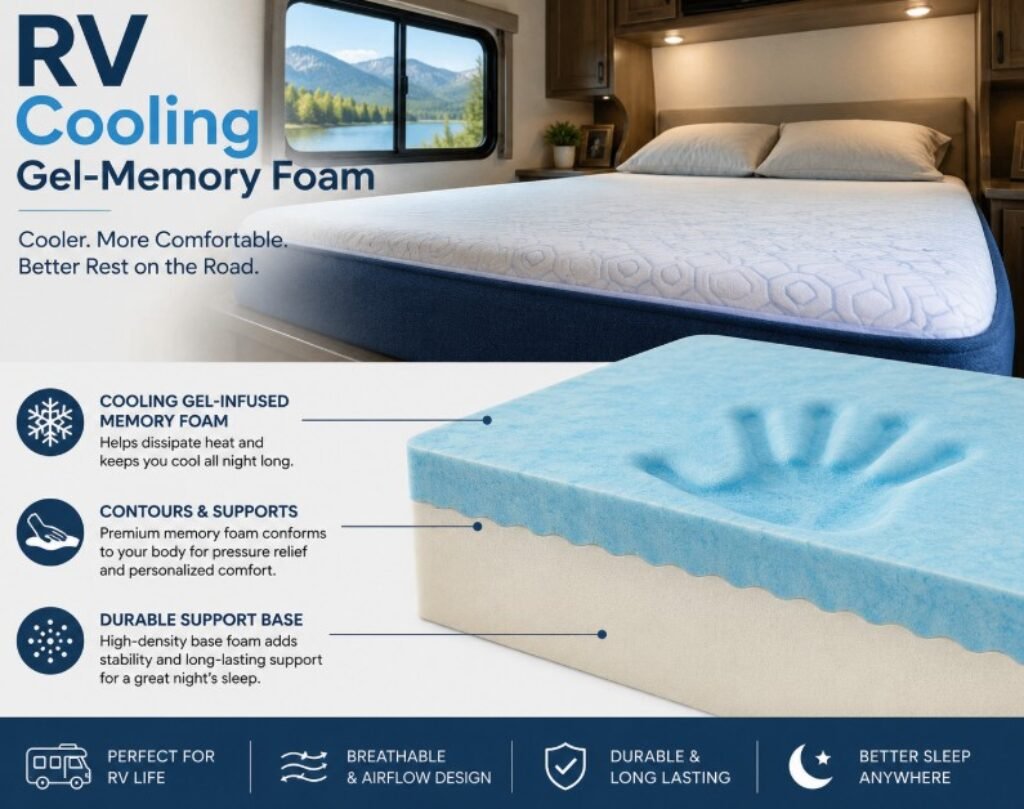
Gel-memory foam is regular memory foam with gel mixed in. Sometimes the gel comes as tiny beads blended into the foam. Sometimes it’s a swirl of gel you can see right in the material. Other times, the gel sits as its own layer near the top of the bed.
The gel’s job is to pull heat away from your body when you first lie down. And it works — for a while. But here’s the honest part: gel can only soak up so much heat. Over a full night, it can warm up and stop feeling cool. So it takes the edge off, but it won’t keep you cold until morning.
Gel isn’t the only cooling trick out there, either. When you shop, you may also see open-cell foam, which is built to let more air pass through. Some foams are infused with copper or graphite to move heat away. Others have a wavy, grooved surface to create tiny air channels. Knowing these terms helps you read a spec sheet instead of just trusting the word “cooling” on the label.
Topper or Full Mattress: Which One Fits Your Rig
Once you decide you want cooler foam, you’ve got a choice to make. Do you add a topper, or replace the whole bed?
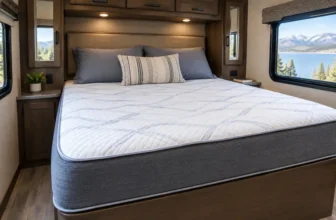
A cooling gel topper is usually 2 to 3 inches thick. It lays right on top of your current bed. It costs less, weighs less, and is an easy upgrade you can do in five minutes. If your stock mattress is still in okay shape and you just want it to feel cooler and softer, a topper is a smart, low-cost pick.
A full gel-foam mattress is a bigger step. It costs more and adds more weight. But it also fixes a saggy, worn-out stock bed at the same time — and many camper mattresses are pretty thin and cheap from the factory. If your current bed is past its prime, replacing it solves two problems at once.
Now for the camper-specific stuff. Weight matters, because every rig has a payload limit — the total weight it can safely carry. A heavy foam mattress eats into that number. Size matters too. Camper beds don’t always match house beds. An RV Queen is often around 60 inches by 75 inches, which is shorter than a standard house Queen. So measure your bed before you buy anything. Don’t guess. Also think about the path from your door to the bedroom — a thick, floppy mattress can be a real pain to wrestle through a narrow camper hallway.
Cooler Foam Works Best as Part of a Plan
Here’s the most important idea in this whole post: cooling foam alone will not fix a stuffy room. The foam only cools the surface you touch. It can’t move the warm air around you. To really sleep better in a hot camper, you need a full plan.
Start with your bedding. Swap heavy sheets for breathable ones, like cotton or bamboo. These let heat escape and pull sweat away from your skin. A great cooling bed under hot, thick sheets still sleeps warm.
Next, get air moving. A small 12V fan uses very little power and makes a big difference. Point it across the bed, not just at the ceiling. If you can, crack a window and open a roof vent at the same time. That creates a cross-breeze that pushes hot air out and pulls cooler air in.
You can also help the bed itself breathe. A ventilated mattress pad or a slatted underlay creates a little air space below the bed, so heat isn’t trapped against that solid platform. And don’t forget condensation — campers hold moisture, and damp air feels warmer and stickier. Good airflow helps with that too.
The simple way to remember it: foam handles the surface you lie on, and airflow handles the room. You need both.
What to Look For When You Buy
When you’re ready to shop, run through this quick checklist:
- Thickness and density: A topper of 2 to 3 inches is plenty for most folks. Higher density lasts longer but weighs more.
- Gel type: Look for details on whether it’s gel beads, a gel swirl, or a gel layer — and pair it with other cooling features if you can.
- CertiPUR-US label: This certification means the foam was tested for certain harmful chemicals. (Worth double-checking the current standard, since these can update.)
- Correct camper size: Measure your bed and match it. Don’t assume it’s a house size.
- Weight: Keep your payload limit in mind, especially in smaller rigs.
- Off-gassing: New foam often has a smell at first. Plan to air it out for a day or two before you sleep on it.
Return policy: A sleep trial or return window lets you test it risk-free.
The Bottom Line
Cooling gel-memory foam is a real, worthwhile upgrade. It makes your bed feel cooler and more comfortable, and it takes the edge off a warm night. But it’s one layer in a bigger plan — not the whole answer.
For the best results, pair cooler foam with breathable sheets, a fan, and good airflow. Start with whatever fix fits your budget and your rig, and build from there. A cool, restful night in your camper is closer than you think.