 Mike Lee
It was 2 a.m. in a Walmart parking lot in Amarillo.
A semi pulled in three spaces over. Engine idling. The driver climbed out, slammed the door, and slept through the night while I lay awake counting the seconds between each diesel knock.
That was the night I got serious about curtains.
Here’s the thing about camper walls
They’re thin.
Most RV walls are less than 2 inches thick. The cores are hollow. Sound walks right through.
Your stock curtains? Useless. They’re decorations.
But heavy curtains can cut perceived noise by 5–10 decibels in the right setup. That’s about half as loud to your ear. That’s the difference between “I can’t sleep” and “I’m out by 10:30.”
What curtains can and can’t do
They can’t soundproof your rig. Anyone telling you that is lying.
Real soundproofing means mass, sealed gaps, and dense walls. A curtain is fabric. Fabric only goes so far.
Here’s what curtains actually do well. They kill mid and high-frequency noise. Voices. Road hiss. Footsteps on gravel. Dogs.
What they can’t kill is the deep stuff. Diesel idle. Generator hum. For that, you need other tricks (more on that later).
How sound actually moves through fabric
Sound is a wave.
When it hits something soft and heavy, some of it gets absorbed. Some bounces back. Some still gets through.
Thin fabric? Most of the wave passes right through. That’s why those stock RV curtains do nothing.
Heavy fabric blocks more of the wave and absorbs more of what’s left. Simple as that.
What to look for in a good curtain
Don’t just buy “blackout” and hope.
Look at the weight. The construction. The size. Here’s what matters:
Fabric weight: 280 GSM or higher. GSM means grams per square meter. Heavier = better. (300+ is even better if you can find it.)
Triple-weave or foam-backed. Multi-layer beats single-layer every time.
Wide coverage. Your curtain needs to extend 6–12 inches past the window on each side. Sound finds gaps.
Floor-length. Short curtains leave a sound highway under the hem. Let them puddle a little Material. Velvet, suede, and dense microfiber win. Polyester blends lose.
The 5 best curtain styles for the camper bedroom
I’ve tested a bunch. Here are the only ones worth your time.
1. Triple-weave blackout/thermal curtains
The best all-around pick.
They run 280–300 GSM. Block 99% of light. Dampen mid-range noise well.
You can find a pair for $30–$60. They install on a standard rod. Easy win.
Trade-off: they won’t touch a diesel idle. For that, you need something heavier.
2. Heavy velvet drapes
Velvet is the gold standard for sound absorption.
The fuzzy surface scatters sound waves instead of bouncing them back. It looks great too.
Cost: $80–$150 a pair. Weight: 5–8 pounds per panel.
That weight matters if you’re close to your cargo carrying capacity (CCC). Worth it for full-timers. Maybe overkill for weekenders.
3. Soundproof curtains with mass-loaded vinyl (MLV)
MLV is the real deal.
It’s a flexible, dense material that pros use for actual soundproofing. Some curtains sew a thin MLV layer into the back.
Closest thing you’ll get to true sound blocking in a curtain. Cost runs $100–$200 a pair.
Trade-off: weight. These panels can hit 10–15 pounds each. Not great for a Class B.
4. The layered setup
Two curtains. One inside, one outside. An air gap between them.
You hang a blackout panel on an inner rod. Then a velvet or acoustic panel on an outer rod. About 2–4 inches of air between them.
That air gap is the secret. Sound loses energy passing through layers with air between them.
(Same idea as double-pane windows. It works.)
5. DIY moving blanket curtains
The budget hack.
Moving blankets are dense, heavy, and close to dedicated acoustic panels in performance. About $20 each.
Add grommets or sew on a rod-pocket tape. Done.
They look ugly. So hide them behind a nicer curtain. Two-for-one win.
Install matters more than the curtain
You can buy the best curtains on the market and still hear every truck on I-40.
Why?
Because the install is wrong.
Here’s what fixes that:
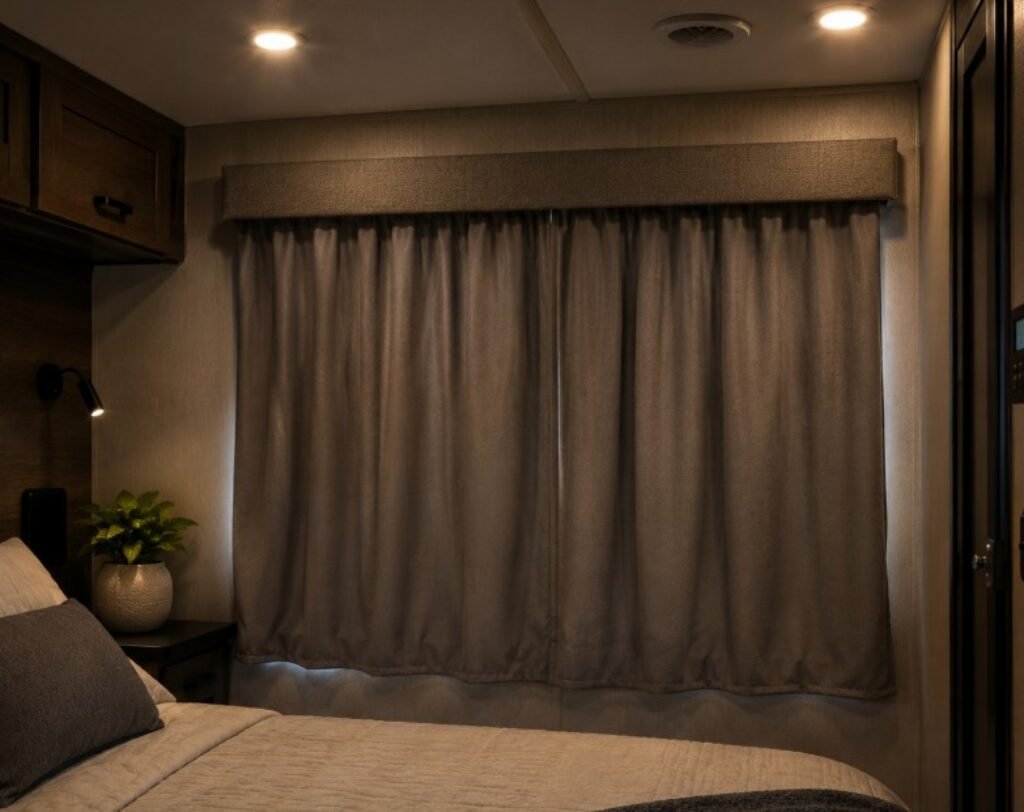
Mount the rod on the ceiling. Not the window frame. This closes the top gap, which is where most sound leaks in.
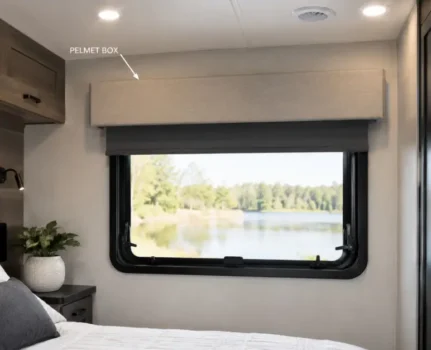
Add a valance or pelmet box across the top. A wood box or fabric valance seals the air gap above the curtain. Biggest single noise upgrade you can make. I’m not kidding.
Use velcro or magnets along the sides. Seal the panel edges to the wall. Sound finds every gap.
Overlap your panels in the middle by 4–6 inches. A center gap is a sound leak. Same idea. Add weight to the hem. Sewn-in chain weight keeps the curtain flush. Stops it from flapping when the A/C kicks on too.
What to pair curtains with
Curtains don’t work alone. They work in a stack.
Add these:
- Reflectix panels behind the curtain. Adds mass. Helps with heat.
- Weather stripping around the bedroom door and slide seals. Cheap. Effective.
- A white noise machine or fan to mask what curtains miss. Generator hum mostly.
- A memory foam topper on your bed. Dampens vibration noise traveling through the frame.
- Rugs in the bedroom. Cuts echo. Makes the space feel quieter.
None of these is magic on its own. Together? Big difference.
Mistakes I see all the time
Read any RV forum thread on noise and you’ll see the same complaints.
“I bought soundproof curtains and they don’t work.”
Nine times out of ten, it’s one of these:
- Curtains too small for the window opening.
- Mounted too close to the window frame (you actually want a 2–4 inch air gap).
- Skipped the top and side seals entirely.
- Ignored bad slide-out rubber (curtains can’t fix that).
- Went too light on weight to save payload. Light fabric doesn’t block sound.
Don’t be that person.
Quick FAQ
Do soundproof curtains really work in a camper? They reduce noise. They don’t eliminate it. Expect a 5–10 decibel drop with a solid setup.
How much weight will heavy curtains add? A pair of velvet or MLV-backed curtains runs 10–25 pounds total with hardware. Check your CCC before you buy.
Can I use residential curtains in the camper? Yes. You usually should. Most “RV curtains” sold online are too thin to do anything for noise.
Do blackout curtains block sound too? Some do. Triple-weave blackout in the 280+ GSM range helps with both. Thin blackout doesn’t. Cheapest way to quiet the bedroom? Moving blankets on a rod. About $25 in materials. Surprisingly effective.
What to do next
Start with one good pair.
Hang it on the noisiest window in your bedroom. Use a ceiling mount. Add a pelmet box on top.
Sleep on it for a week. See what changes.
Then layer up from there.
That semi in Amarillo doesn’t have to win again.